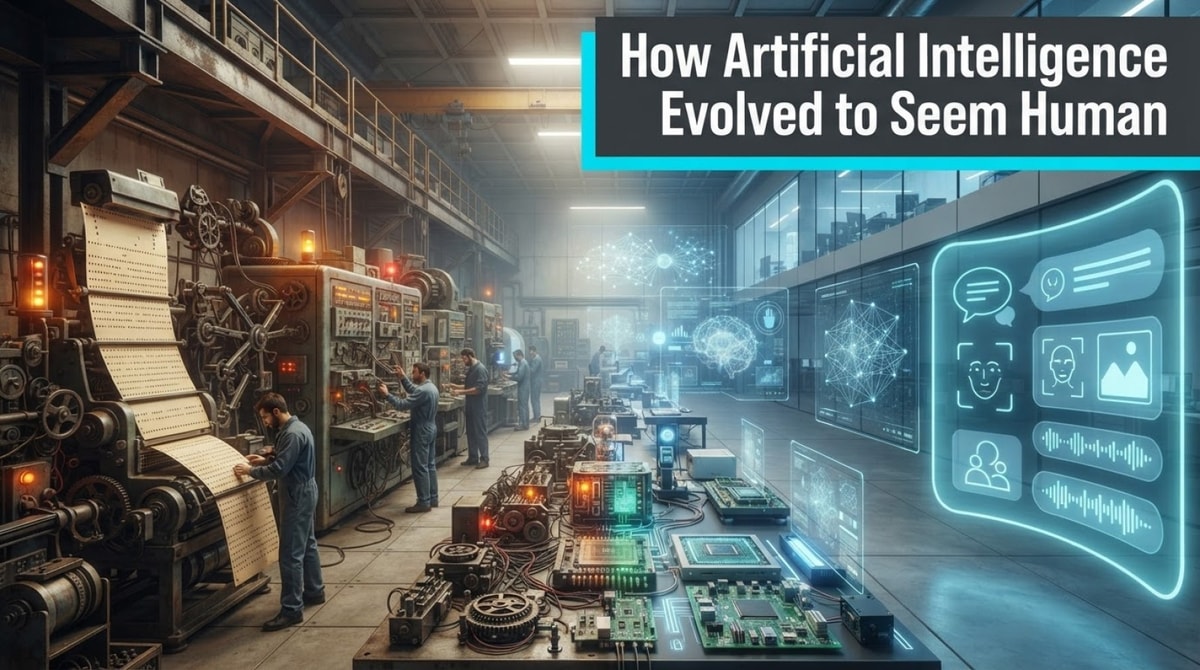
Artificial intelligence became more human-like by moving from hand-written rules to systems that learn patterns from enormous amounts of data. Modern models can produce fluent text, code, images, and voice conversations, but convincing output does not mean they possess a human mind.
The useful question is not whether AI is secretly conscious. It is how well a system follows context, handles ambiguity, and recovers from mistakes. ChatGPT and Claude show the value of this progress in different ways, yet both remain tools whose answers require judgment and checking.
What human-like AI actually means
“Human-like” AI describes how a system communicates, not what it experiences. In practical terms, it usually means fluent language, the ability to follow a conversation across several turns, and access to inputs or outputs such as images and voice. A model may rewrite an email in a warmer tone, explain a photograph, or continue a complicated discussion without forcing you to restate every detail. Those behaviors feel familiar because they resemble skills people use in ordinary conversation.
That impression has a clear limit. AI models process language through patterns in tokens, the small pieces of text used to represent it. They estimate which sequence is likely to fit the request and the conversation so far. They do not understand context through personal memory, physical experience, or inner awareness in the human sense. A reply can sound concerned, confident, or self-aware while being generated without feelings or private experience behind it.
The quality of the conversation is better treated as a result of training and system design than as proof that the software thinks like a person. Models can connect instructions, tone, and earlier details with impressive consistency, but they can still invent facts, miss a hidden assumption, or follow a flawed premise. Fluent language is an interface achievement, not evidence of consciousness or general intelligence. That distinction matters when you judge ChatGPT or Claude: evaluate the accuracy, control, and failure modes of the work, not the personality suggested by the wording.
From coded rules to generative models
The shift began with systems that could act only inside rules written by people. An early expert system might use a chain of if-then instructions to diagnose a narrow problem or recommend an action. This approach was understandable and useful within its boundary, but it required someone to anticipate the relevant cases. A new phrasing, missing detail, or situation outside the script could send the system toward a dead end. Rule-based software did not become flexible simply because its rulebook grew longer. Maintaining every exception became the central weakness.
Statistical learning changed the question. Instead of encoding every possible response, developers gave models data and methods for finding recurring patterns. The system could associate words, signals, or images with likely outcomes without receiving a separate hand-written instruction for each case. It still depended on the quality and limits of its training material, and pattern recognition was not the same as human understanding. The approach did handle variation better than a fixed decision tree.
- Rule-based systems: people specify the logic, so results can be predictable but brittle outside the planned scenario.
- Statistical learning: the model extracts regularities from examples, making it more adaptable while leaving room for biased or incorrect patterns.
- Generative models: the system uses learned relationships to produce new language, code, images, or other outputs instead of selecting only from prewritten replies.
When every answer had to be programmed
In a rule-driven system, a useful answer depended on the programmer having already described the route to it. The software could be effective for a narrow, stable task, but it struggled with synonyms, incomplete requests, and unexpected combinations of facts. A person could recognize the intention behind a vague question; the rule engine usually needed another explicit condition. That is why older systems often felt mechanical even when their permitted decisions were reliable.
What large language models actually do
A large language model generates the next stretch of language from patterns learned during training. It uses the prompt and earlier text to estimate what sequence should follow, then repeats that process to build an answer. The same mechanism can produce a paragraph, suggest code, continue dialogue, or transform instructions into another format. This flexibility makes ChatGPT and Claude feel conversational, but it also explains why a polished answer can contain an unsupported claim. The model is extending patterns, not consulting a human-like mind with guaranteed access to truth.
Writing quality in ChatGPT and Claude
Which is better for writing, ChatGPT or Claude? The answer changes with the kind of writing you need. ChatGPT works as a broad assistant that can move from drafting and coding to images, voice, and photo-based questions, while Claude is positioned around natural conversation, long-form writing, coding, research, and knowledge work.

That difference appears in the surrounding product experience, not only in the wording of one reply. Users in Reddit discussions in r/ClaudeAI often report that Claude feels more natural and capable in conversation than rival chat models. ChatGPT offers a broad set of everyday tools, while the dated store figures below show a larger Android install count. Ratings, install counts, and plan details can change, so the comparison is dated 3 September 2026.
| Criterion | ChatGPT | Claude |
|---|---|---|
| Writing feel | Flexible and general-purpose, with writing, coding, advice, and everyday tasks in one assistant. | A natural conversational tone with emphasis on long-form writing, research-style work, coding, and knowledge tasks. |
| Extra modalities | Image generation, Advanced Voice Mode, and photo upload are described in the official Android listing. | Writing and coding support, research with citations, and connections to workplace tools are described in the official Android listing. |
| Platforms | Web, Android, iOS, macOS, and Windows, with availability subject to change. | Web, iOS, Android, and desktop, with availability subject to change. |
| Plan access | The download is free, while paid feature access varies by tier. Confirm current plans on OpenAI’s ChatGPT pricing page as of 3 September 2026. | The download is free, while current paid prices and exact plan limits remain unconfirmed here. |
ChatGPT’s Android listing shows a 4.77/5 rating from 54,801,174 ratings and 1,000,000,000+ installs as of that date. Claude’s listing shows 4.49/5 from 668,113 ratings and 50,000,000+ installs. Those figures indicate reach and store reception, not writing accuracy, originality, or reliable judgment.
Where ChatGPT and Claude still fail
A fluent paragraph is not proof that a model understands the subject behind it. ChatGPT and Claude can invent facts, lose track of earlier instructions in a long context, and present an incorrect answer with the calm confidence of a finished report. Human-like language describes the interaction style, not a human ability to verify every claim or preserve every detail.

The weaknesses are not identical in user reports. Discussions in r/ChatGPT and r/ChatGPTcomplaints describe ChatGPT as producing shorter or more restricted answers on some advanced work. Other reports describe an overly cautious or patronizing tone that gets in the way of practical tasks, along with lost context and inconsistent decisions across long projects. These are reported patterns, not universal behavior in every conversation.
Shorter answers, extra caution, lost threads
ChatGPT’s broad feature set does not remove the friction of managing a demanding project. A response may become more guarded than the task requires, omit useful detail, or stop following an earlier constraint after a long exchange. For reports, code plans, and multi-stage drafts, keeping a separate source of truth and restating critical requirements is safer than trusting conversational memory alone.
Natural tone without human understanding
Claude’s natural tone can make a draft easier to read and a discussion easier to continue, but it does not turn generated prose into verified knowledge. Its writing and research-oriented positioning still leaves room for hallucinated claims, missing context, and weak interpretation of ambiguous instructions. A polished explanation can therefore need the same source checking as a stiffer-sounding answer.
Where the two assistants actually stand, by the numbers
Read on Google Play on 3 September 2026: ChatGPT from OpenAI holds 4.77 out of 5 from 54,801,174 ratings and has passed 1,000,000,000 installs, while Claude from Anthropic PBC holds 4.49 out of 5 from 668,113 ratings on more than 50,000,000 installs.
That is an 82x gap in review volume against a 0.28-point gap in average score, and it is the single most useful thing to know before reading anyone's opinion about which model "feels" more human. A 4.49 built on 668,113 ratings comes almost entirely from people who sought the app out; a 4.77 built on nearly 55 million comes from everyone, including people who installed it because they heard the name. The two numbers are not measuring the same population, so a head-to-head on store rating alone tells you very little about capability and quite a lot about reach.
When ChatGPT fits and when Claude does
Pick ChatGPT when you want one general assistant with image generation, voice, photo tools, coding help, and broad mobile and desktop access. Pick Claude when the main job is long-form writing, research-style knowledge work, or a more natural conversational tone. Neither is a human stand-in. Skip either one for facts, long-project consistency, or decisions that require verified grounding unless you check the important claims yourself.


Comments
2Can i use Claude free limit
yes, you can use claude free limit